Watch this video about how to do crashing waves.
Discussion about watercolor painting. Learn on how to use a watercolor and their techniques. Hope these info can help you to improve your watercolor technique.
Monday, November 1, 2010
Friday, October 29, 2010
Monday, October 11, 2010
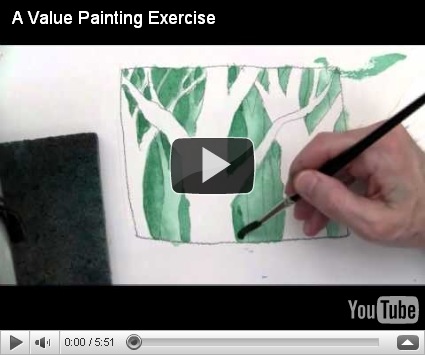
Painting Exercise Value
Watch this above video. Read, click and try product from the bottom of this blog under sponsor links. Hope it can help you for better technique.
Friday, June 25, 2010
Mixing The Colors in Watercolor Painting
Some info about it.
Watercolor out of the tube or the pan is at its full paintable strength. Seldom will it be used in that manner except when the design calls for it. However, the use of full strength color is by large discouraged due to bronzing when watercolor applied to the paper dries. Diluting and mixing color pigments with water changes its values, depth, and hue. When applying watercolor though, an important thing to remember is that the color will tend to be lighter when the color dries. If you want stronger color, you can make adjustments by applying slightly stronger hues before application or you can dab some more color to the object when the paint is already dry.
Creating test sheets
Before attempting to mix watercolor pigments, it is advisable to test out the colors first on a clean paper to get a good grasp on how it behaves and the color when it dries. Paint on a damp paper the colors that you will use. Maintain a uniform brush stroke starting with the lightest color to the stronger ones. Label the color and maintain a clean brush while doing the strokes. When the paints are dried compare it to the colors in your color well to judge how the final outcome of the colors will be.
Mixing a Puddle of Color
To start your puddle, wet the brush in clean water. This opens up all the hairs in the brush up to the ferrule. At this point, your brush would likely be fully loaded with water, if so, remove excess water by thumping the brush a few times or run the brush across the rim of the mixing well.
Add the first color (red for example) by touching the tip of the brush across your pigment and dilute it some more with your puddle of water. Start watercolor painting and continue the process until you get the color value that you desire.
You do not need to wash your brush if you want to add another color for combination. Touch the tip of your brush to a new color (Green for example), dilute it with your puddle of water, and apply it over the blue or parts of the blue that you painted previously. Continue adding strokes until the correct color is achieved.
To keep tube and pan colors pure, place small amounts of the pigments in a separate well. This way, all your colors stay clean and will not intermingle with another.
Practice mixing primary Colors
To achieve a very good grasp on how colors behave and how it will affect your work, it is advisable to practice with primary colors. Primary colors are the colors Red, Blue, and Yellow. Combining these colors in different degrees will give you infinite color combinations. Most professional artists use only these colors and have created masterpieces out of them.
Friday, June 18, 2010
Mix color
If you buy a tin of six basic colors that I proposed at the end of my basic needs, this topic will help you learn to mix colors actually are. I suggest you start with small amounts and mix the colors and those for a while 'all familiar with what they can do, you can always add more color palettes you as you get more experienced. Here are the six colors (with their successors) that I recommend as a starting color. (AP) is Winsor & Newton Artists' Watercolor, (GRA), is about to Grumbacher Academy watercolors. The color of the first list is my first choice and higher cat as a whole, but because the audience asked me a cheaper alternative, I included the color Grumbacher Academy. However, it should be noted that golden yellow and Vermilion Hue is not as lightfast as the Winsor & Newton alternatives.
Color mixing isn't complicated if you stop and think first about what color you want to end up with. For example, if you want a "pure" vibrant purple, mix it from a red and blue that both share or are biased toward purple–permanent alizarin or thalo crimson and french ultramarine or ultramarine (permanent blue). If you want a slightly duller, less intense purple, use the orange-biased red (organic vermilion) and purple-biased ultramarine blue. If you want a very greyed purple (hardly purple at all!) use the orange-biased red with the green-biased blue.
This same theory applies to all your other hues. The purest, most intense mixtures come from combining two primary colors that lean toward (are "biased" toward) the same secondary color.
The more colors you mix together, the grayer (duller) and less pure your mixtures will become as you can see from the mixtures below. The lines connect the two primary colors that were mixed in each case. Notice that when you cross the black dotted lines into an adjacent color quadrant that the mixtures are duller.
Colors that are opposite each other on the color wheel (like red and green, for example) will also neutralize each other when mixed, and make a grayish, brownish color. Try to mix the color you want using no more than three colors. Start with the lightest of the two colors, and add the darker one to it, a little at a time, until you get the result you want. Remember that watercolor dries lighter, so what you see in your palette should be a deeper, more saturated mix to compensate for this drying shift.
Sponsor Links
Real Art Lesson Workshop
Learn How to Paint Realism in Oils
Capture the joy of painting!
www.easy-oil-painting-techniques.org
Basic Paint Kit Tutorial
Digital Painting with Chad Baldwin!
Setting up the Scene with Lights!
www.cartoonpaint.com/
Step-By-Step Watercolor Guide
Learn To Paint Beautiful Watercolors Perfectly!
Stop trying to create original artwork the hard way!...
www.learn-watercolor-painting.com